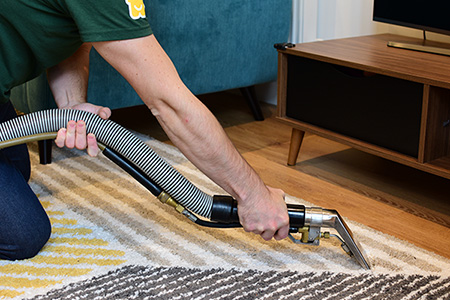
A stained mattress can be a serious issue, especially when the spot is from a large spill, or worse, from an accident. No one likes a dirty bed, to the point that people often start to wonder: Can I clean it, or is the mattress now ruined? The truth is that not all mattress stains are the same. Some can be successfully treated, others only improve partially, and a few actually lead to the more practical and hygienic option of replacing the mattress.
Our skilled London mattress cleaners put together this guide on the most common mattress stains and which of them can be safely and successfully removed. We hope it can help you answer the question: Can I save my mattress or not?
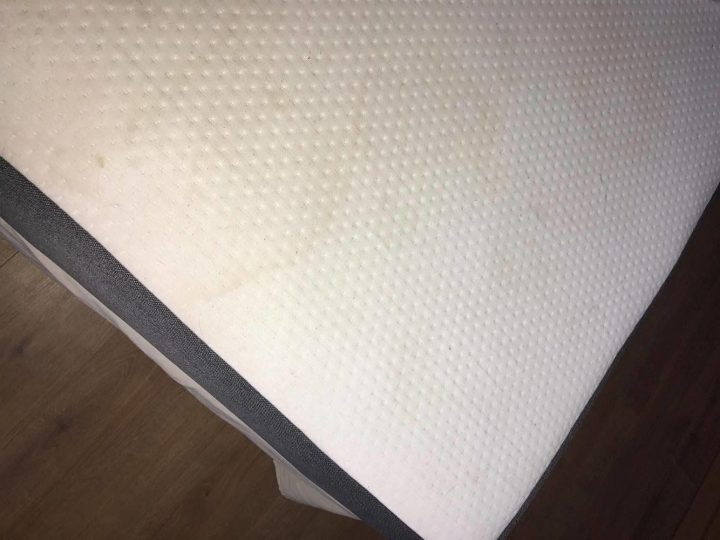
Sweat and sebum usually leave yellowish stains. Flickr
Why mattress stains are more complicated than they look
Unfortunately, cleaning a mattress is not as simple as treating its surface. When a stain seeps through the sheets and reaches the mattress, it usually gets past its surface. Depending on how wet the stain is, the liquid can travel through the fabric cover, seep into the padding layers, and settle deep into the foam or fillings.
Even if a stain doesn’t spread wide and looks small on the surface, this doesn’t mean there is no moisture inside the mattress where it is much harder to remove. Over time, trapped moisture can lead to bacterial growth, foul odours, allergen build-up, and permanent discolouration. This is why even two stains from the same substance can require a completely different removal approach – a few drops of coffee can usually be cleaned with ease, while spilling the whole cup usually requires professional treatment.
Check also: How Often to Clean Your Mattress for Healthier Sleep
Can it be saved? Common mattress stain guide
Some stains are more stubborn than others, and the longer they’re left untreated, the harder they become to remove. The most common stains we see when called in for mattress cleaning include sweat, sebum (body oils), blood, urine, vomit, coffee or tea, and mould*. Each of these creates bonds with mattress fibres and fillings in a slightly different way.
Read also: How to Clean Bloodstains from Upholstery
*Mould isn’t technically a stain but a fungus, and it’s a serious hygiene issue so if you notice mould anywhere in your home you can try these 6 cleaning products to remove it.
Here’s a quick look on how treatable different stains are:
| Stain | Can it be cleaned? | Replace if… |
| Sweat, sebum | Usually yes | Extensive yellowing and lingering odour remain after cleaning |
| Blood | Often | There is a large amount of blood, or the stain is old or deeply set |
| Urine | Often, especially if treated quickly | Repeated accidents have soaked the mattress core or odours persist |
| Coffee / Tea | Usually | The spill has been left untreated for a long time and caused permanent discolouration |
| Red Wine | Sometimes | The dye has permanently stained the fabric or penetrated deep into the filling |
| Vomit | Often, if treated promptly | Large liquid absorption, persistent odour, or repeated contamination |
| Mould | Sometimes | Mould has spread into the inner layers or keeps returning after cleaning |
Please, use this table as a guide rather than a strict rule. The overall condition of the mattress and how quickly the stains are treated often matters more than the stain itself.
Read also: What Causes the Yellow Mattress Stains and How to Remove Them
What really determines whether a mattress can be saved
Even the same type of stain can have very different outcomes depending on a few key factors:
1. How long the stain has been there
Fresh stains are usually much easier to treat. Once a stain has dried and set over time, it becomes significantly more difficult to remove fully.
2. How deep it has penetrated
Surface stains are often manageable. If liquid has reached the inner filling, odours and bacteria are more likely to remain trapped inside.
3. Size and saturation
A small spill is very different from a mattress that has been heavily soaked with liquid.
4. Whether there is an odour
Odour is often a more important indicator than appearance. If a mattress still smells after drying, contamination is likely still present deep within the layers.
5. Age and condition of the mattress
Older mattresses are less resilient. If a mattress is already worn or nearing the end of its lifespan, deep cleaning may only offer a temporary improvement.
Check also: How to Maintain your Mattress Odour-Free

Professional cleaners can remove most stains if called in soon after they occur.
When professional cleaning can usually save a mattress
In many cases, professional cleaning can successfully restore both the hygiene and appearance of your mattress. This is especially true when stains are relatively recent and the contamination is localised to a specific area. If odours are present but not deeply embedded, a deep clean can usually solve the problem.
Professional mattress cleaning is also highly effective when there has been a single accident rather than repeated exposure to liquids. Beyond the visible marks, professional cleaning can help with issues that aren’t always obvious, such as allergens, general dirt build-up, and the bacteria that naturally accumulate over time.
Read also: The Hidden Allergens in Your Home (and How to Get Rid of Them)

Urine stains are especially tricky because if they are left untreated, they can turn brown, harbor bacteria, and develop unpleasant odours. Flickr
When replacing your mattress is usually the better option
Sometimes, cleaning can improve the condition of a mattress but cannot fully restore it. Replacement is usually the more practical option when there is widespread mould growth. You should also consider a new mattress if the bed has been repeatedly contaminated, especially with urine, vomit, and other bodily fluids, or if strong odours remain after thorough cleaning attempts.
Furthermore, if the structure of the mattress has been affected, leading to sagging or the breakdown of fillings, cleaning won’t fix the damage. The same applies if the mattress is very old and already heavily worn. In these cases, further cleaning may only provide a short-term improvement rather than a long-term solution.
Check also: 7 Signs It’s Time to Get a New Mattress
What NOT to do when cleaning a stained mattress
It’s very common for people to unintentionally make stains worse while trying to fix them. You should always avoid over-wetting the mattress, as this simply pushes the liquid deeper inside the filling and can lead to mould growth inside the mattress filling. Stay away from bleach or harsh chemicals, and never scrub the fabric aggressively, because this can damage the fibres and spread the stain further.
It is also a bad idea to cover the stain with sheets or a protector without treating it first. Finally, always allow enough drying time. A mattress that doesn’t dry properly can develop lingering odours or dangerous mould over time.
Read also: 5 Simple Steps to Keep Your Mattress As-New

Professional steam cleaning can give a second life to your mattress
How to increase the chances of saving a stained mattress
If an accident happens, acting quickly makes a significant difference. Here’s what you can do to give your mattress the best chance of recovery:
- Always blot spills immediately with a clean cloth rather than rubbing the fabric.
- Avoid soaking the bed during the cleaning process.
- While the mattress is drying, open windows or turn on a fan to help ventilate the room.
- Adress odours early, don’t wait to see if they vanish on their own.
- Avoid layering multiple cleaning products to prevent unwanted chemical reactions and damage.
- If the mattress stain is large or soaked deep in the filling, seek professional help immediately.
A stained mattress doesn’t automatically mean it needs to be replaced. In many cases, especially when treated quickly, professional cleaning can restore both hygiene and appearance effectively.
However, the key factors are always the same: time, depth, and severity. Once contamination becomes deep, repeated, or long-lasting, replacement may be the more practical and hygienic decision.
If you’re unsure, it’s often worth getting a professional assessment before deciding to replace a mattress entirely. Many cases that look serious at first can still be improved significantly.
Call The Happy House Cleaning and hire the best mattress cleaners in your area to save your mattress.